

مبادي قياس الضغط Principles of Pressure Measurement – الجزء الثاني
الوسوم:Pressure, Pressure Control, حساسات الضغطهذه المقالة من إعداد صديق الموقع Mohamed Rezk
العناصر الكهربية لقياس الضغط Pressure Transducers
تحدثنا في الجزء السابق عن عناصر القياس الأساسية المستخدمة في الأجهزة النيوماتية (الهوائية) Pneumatic ، واليوم نتابع الحديث ولكن عن عناصر القياس الأساسية المستخدمة في الأجهزة الإلكترونية .
مقاييس الإنفعال Strain Gauges
وهذا النوع يستخدم سلك معدني أو رقاقة من أشباه الموصلات لقياس التغيرات في الضغط . حيث يتسبب تغير الضغط علي الرقاقة في تغير المقاومة نتيجة حدوث تشوه (انفعال) للمعدن .

شكل رقم (1) : توضح للدائرة الكهربية لمقياس انفعال Strain Gauge
عندما يتم تطبيق ضغط علي هذه الرقاقة يحدث انفعال بمعني يميل الطول الكلي للزيادة مما يتسبب بتغير قيمة المقاومة بقيمة تتناسب مع مقدار الضغط المطبق . وباستخدام قنطرة ويتستون يتم قياس التغير في المقاومة، ويتم تحويل عدم الإتزان في القنطرة إلي إشارة 4 -20 مللي أمبير .
هناك العديد من التصميمات المختلفة لأجهزة استشعار الضغط باستخدام مقاييس الإنفعال Strain Gauges ، لكن التصميمات الأكثر شيوعا تستخدم الغشاء المعدني Metallic Diaphragm لعزل مائع العملية الصناعية عن مقياس الإنفعال Strain Gauge وممارسة قوة على عمود القوة Force bar، والذي بدوره ينقل حركة الغشاء المعدني إلي مقياس الإنفعال Strain Gauge ثم تتحول إلي إشارة كهربية كما ذكرنا آنفاً . وتستخدم هذه العناصر لنطاقات من (0- 750 mmH2O) وتصل حتي (0-10000 PSI).
Strain Gauges
Strain gauge sensing uses a metal wire or semiconductor chip to measure changes in pressure (electronic pressure transmitters). A change in pressure causes a change in resistance as the metal
is deformed.
When force is applied the overall length of the wire tends to increase while the cross-sectional area decreases (the electrical resistance will increase).
There are many different designs of strain-gauge pressure sensors. The most common designs use a metallic diaphragm to isolate the process fluid and exert a force on a force bar.
This force bar transfers the diaphragm movement to the strain gauge. Whetstone bridges circuits measure the resistance change. The bridge imbalance is converted electronically to a 4-20 mA signal.
Strain gauge pressure sensors can be used for ranges from 0-30 inches H2O (0 -750 mm H2O) to 0 -10,000 psig (0 -66,000 kPa).
Advantages
– Wide range, 7.5kPa to 1400 Mpa
– Inaccuracy of 0.1%
– Small in size
– Stable devices with fast response
– Most have no moving parts
– Good over-range capability
Disadvantages
– Temperature sensitive
– Thermo elastic strain causes hysteresis
****************************
حساس الضغط السعوي Capacitance Sensor
تعمل هذه الأجهزة على مبدأ التغير في سعة مكثف والناتجة عن حركة عنصر مرن بقيمة مع الضغط الواقع على العنصر المرن .
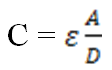
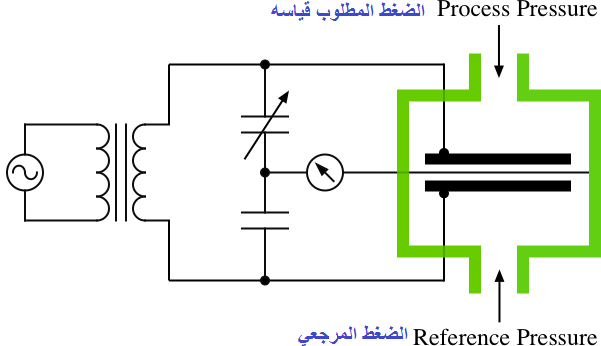
شكل رقم (2) : توضح للدائرة الكهربية لحساس الضغط السعوي Capacitance Sensor
يتحكم عنصر الإستشعار في مذبذب High-Frequency Oscillator ، حيث أن التغيرات في الضغط الواقع تتسبب في حركة العنصر المرن والذي بدوره يؤدي إلي تغير ناتج في السعة Capacitance ، يتغير علي إثره تردد المذبذب .
ويتم تحويل الإختلاف في تردد المذبذب إلى إشارة 4-20 مللي أمبير متناسبة مع قيمة الضغط المطبق . وتصل نطاقات هذا العناصر من 80 باسكال إلي 35 ميجا باسكال .
Capacitance Sensors:
Measure changes in capacitance.
These devices (used in electronic pressure transmitters) operate on the principle that the change in capacitance resulting from the movement of an elastic element is proportional to the pressure applied to the elastic element.
A high-frequency oscillator is controlled by the sensing element.
Changes in pressure deflect the diagram and the resultant change in capacitance changes the oscillator frequency.
The variation in oscillator frequency is converted to a 4-20 mA signal proportional to the pressure.
Advantages
– Inaccuracy 0.01 to 0.2%
– Range of 80Pa to 35MPa
– Linearity
– Fast response
Disadvantages
– Temperature sensitive
– Stray capacitance problems
– Vibration
– Limited overpressure capability
– Cost
**************************
الحساس الكهروضغطي Piezoelectric Sensor
وفي هذا النوع عندما يتم تطبيق ضغط علي بلورات الكريستال Crystal يحدث تشوه (انفعال) يتولد علي أثره شحنة كهربية لعدة ثواني .
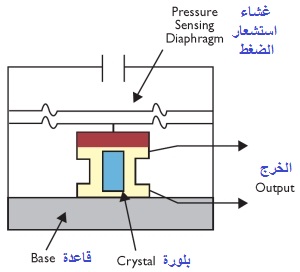
شكل رقم (3) : مكونات الحساس الكهروضغطي Piezoelectric Sensor لقياس الضغط
لاحظ الفرق بين حساس مقياس الانفعال والحساس الكهروضغطي Piezoelectric Sensor :
في النوع الأول حساس مقياس الانفعال يتم تحويل الضغط المطبق إلي تغير في المقاومة نتيجة الانفعال ، هذا التغير في المقاومة يتم تحوله إلي إشارة عن طريق قنطرة ويتستون .
بينما في النوع الثاني الحساس الكهروضغطي عندما يتم تطبيق ضغط فإن البلورة (كريستال) تولد شحنة كهربية تحت هذا الضغط تتناسب مع قيمة الضغط الواقع عليها، ثم يتم تحويل هذه الشحنة إلي جهد كهربي يتناسب معه باستخدام مكبر Amplifier .
Piezoelectric:
When pressure is applied to crystals, they are elastically deformed. When a crystal is deformed, an electric charge is generated for only a few seconds.
Advantages
– Accuracy 0.075%
– Very high pressure measurement, up to 70MPa
– Small size
– Robust
– Fast response, < 1 nanosecond
– Self-generated signal
Disadvantages
– Dynamic sensing only
– Temperature sensitive
Note: When using strain gauges any elastic deformation of the measuring body is first converted to a change in strain gauge resistance, so that a Wheatstone bridge circuit electrical output signal can then be generated.
By contrast the basis of the piezoelectric effect is that crystals under compressive loading generate an electric charge that is directly proportional to the force applied.
This charge is then converted to a proportional output voltage with the aid of an amplifier. The two technologies complement each other perfectly.
**************************
حساس الرنين (الاهتزاز) Resonant-Wire Sensors (Vibrating Wire)
يستخدم هذا العنصر كما العناصر السابقة في الأجهزة الإلكترونية لاستشعار الضغط، حيث تردد الرنين للسلك المهتز يتناسب مع الطول وكتلة السلك والجذر التربيعي للشد Tension ، فإذا كان كلا من الطول والكتلة ثابتين، يمكن القول حينئذ أن الشد في السلك يتناسب مع قيمة الضغط الواقع أ ان تردد الرنين يتناسب مع الضغط .
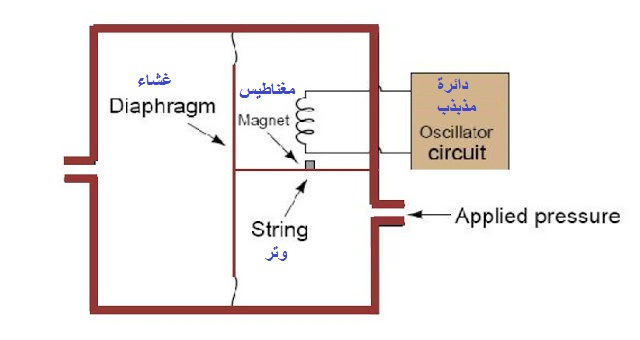
شكل رقم (4) : فكرة عمل حساس الرنين (الاهتزاز) Resonant-Wire Sensors (Vibrating Wire) لقياس الضغط
تتألف الدائرة من مذبذب الكتروني وهو المسؤول عن اهتزاز السلك عند التردد الطبيعي Natural Frequency تحت الشد ، ويوجد غشاء متصل بالسلك المهتز .
كلما تغير الضغط الواقع علي الغشاء يتغير الشد علي السلك المهتز مما يتسبب في تغير التردد. هذه التغيرات في التردد يتم كشفها وتحويلها إلي إشارة .
.
للمزيد من التفاصيل عن هذا النوع قم بالضغط علي رابط المقالة التالية For more click the following Link :
حساس السلك المهتز Vibrating Wire Sensor
*
يتبع،،،،
Vibrating Wire (Resonant-Wire Sensors):
Resonant-wire sensors are used in electronic pressure transmitters. The resonant frequency of a vibrating wire is a function of the length, the square root of the tension, and the mass of the wire. When the length and mass are constant, it can be said that wire’s tension is proportional to pressure then the resonant frequency will be a function of pressure.
It consists of an electronic oscillator circuit which causes a wire to vibrate at its natural frequency when under tension. The vibrating wire is located in a diaphragm. As the pressure changes on the diaphragm so does the tension on the wire which affects the frequency that the wire vibrates or resonates at. These frequency changes are a direct consequence of pressure changes and as such are detected and shown as pressure.
Advantages
– Good accuracy and repeatability
– Stable
– Low hysteresis
– High resolution
– Absolute, gauge or differential measurement
Disadvantages
– Temperature sensitive
– Affected by shock and vibration
– Non linear
– Physically large
**************************
اكتمل الموضوع …..
| الجزء الأول | الجزء الثاني |
لتحميل المقالة في صورة ملف PDF : من هـنـا 
اضغط هنا لتتابع صفحتنا علي الفيس بوك أو
أو 
***************************************************************

مواضيع ذات صلة

*
**************************************
ملاحظة
- إذا كان لديك مقالة تريد نشرها أو لديك تعديل أو اقتراح جيد ، فمن فضلك سجل اقتراحك في تعليق علي الموضوع .
- أو راسلنا
 علي البريد التالي لنشر مقال خاص بك : info@inst-sim.com
مكتبة محاكاة الأجهزة

مقال جميل جدا
الرجاء إرساله إلى البريد الالكترونى
الحقيقة أود تحية كل الناس القائمين على هذا العمل الرائع وكل الأخوة المشاركين. عمل يذكر فيشكر أتمنى لكم كل التوفيق والسداس